



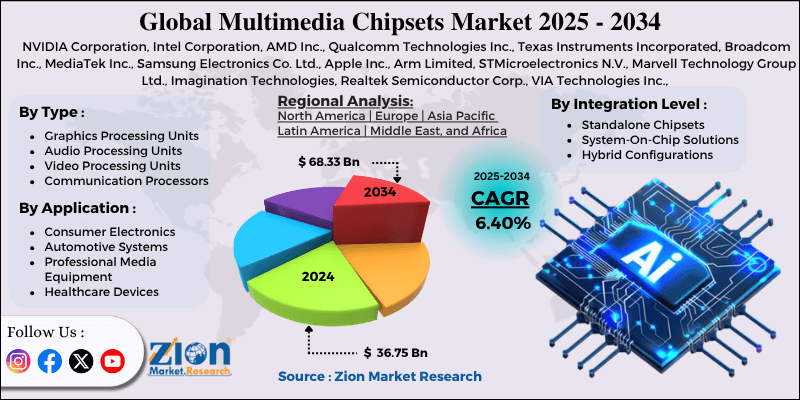
In an era defined by immersive entertainment, real-time communication, and intelligent devices, the unseen engines driving these experiences are multimedia chipsets. These sophisticated Systems-on-a-Chip (SoCs) integrate processors for graphics (GPU), audio, video encoding/decoding, display, and AI acceleration into a single unit. The multimedia chipset market is experiencing explosive growth, fueled by the insatiable global demand for richer content, higher resolutions, and seamless connectivity across consumer electronics, automotive, and enterprise applications.
Market Drivers: Why the Surge?
Several key trends are propelling the market forward:
-
The 4K/8K Revolution & Beyond: The mainstream adoption of 4K UHD displays and the emerging 8K standard demand chipsets with immense processing power for decoding and upscaling content. High Dynamic Range (HDR) and high refresh rates (120Hz+) further push the performance envelope.
-
Proliferation of Streaming & Video Conferencing: The dominance of OTT platforms (Netflix, Disney+) and the hybrid work model necessitate efficient video codecs (like AV1) and powerful encoding/decoding blocks in chipsets for smooth, bandwidth-optimized streaming.
-
Gaming Goes Mainstream and Mobile: The rise of mobile gaming, cloud gaming services, and next-gen consoles requires advanced GPUs and real-time ray-tracing capabilities, making high-performance multimedia SoCs critical.
-
AI Integration Becomes Standard: Modern multimedia chipsets now feature dedicated Neural Processing Units (NPUs) for AI tasks. This enables features like computational photography (smartphone cameras), real-time noise cancellation in video calls, AI-upscaling for older content, and intelligent voice assistants.
-
The Connected Everything Ecosystem: From smart TVs and AR/VR headsets to advanced in-vehicle infotainment (IVI) systems, every connected device requires a capable multimedia processor to handle diverse audio-visual inputs and outputs.
Market Segmentation: Diverse Applications
The market is broadly segmented by application:
-
Smartphones & Tablets: The largest segment, where chipsets (like Qualcomm Snapdragon, MediaTek Dimensity, Apple A-series) are central to performance, camera quality, and battery life.
-
Consumer Electronics: Includes Smart TVs, streaming devices (Roku, Fire Stick), gaming consoles, and drones. Chipsets here prioritize media playback, connectivity, and specific use-case optimizations.
-
Automotive: In-car systems are evolving into entertainment hubs with multiple high-resolution displays, surround sound, and driver-assistance visuals, requiring robust, automotive-grade chipsets.
-
Computing: Laptops, desktops, and emerging Arm-based PCs integrate multimedia capabilities for creative work, video editing, and gaming.
-
Enterprise & IoT: Video conferencing systems, security cameras, and digital signage rely on specialized chipsets for efficient video processing and analytics.
Competitive Landscape: A Battle of Giants and Specialists
The market is characterized by intense competition:
-
Leading Fabless Chip Designers: Qualcomm, MediaTek, Apple, and NVIDIA dominate in mobile and compute spaces, leveraging integrated modem and GPU expertise.
-
Broad-Based Semiconductor Leaders: Companies like Intel (for PCs and servers) and AMD (GPUs and APUs) are key players.
-
Specialized & Emerging Players: Samsung (Exynos), HiSilicon (Kirin), and Allwinner Technology cater to specific segments. New entrants are focusing on niche areas like automotive or ultra-low-power IoT devices.
The competition revolves around process node advancement (5nm, 3nm), AI performance per watt, software ecosystem support, and integration of cutting-edge features like hardware-accelerated AV1 decoding.
Challenges and Considerations
-
Design Complexity & Cost: Integrating more functions onto a single die increases design complexity, R&D cost, and reliance on expensive advanced semiconductor fabrication nodes.
-
Thermal Management: Packing more performance leads to heat dissipation challenges, especially in slim devices like smartphones.
-
Fragmented Standards: While codecs like H.264/265 are universal, newer ones like AV1 require industry-wide adoption to justify dedicated silicon.
-
Geopolitical & Supply Chain Issues: Trade restrictions and semiconductor shortages have highlighted vulnerabilities in the global supply chain.
Future Outlook: Intelligent, Immersive, and Ubiquitous
The future of the multimedia chipset market points toward:
-
Ubiquitous AI: NPUs will become more powerful and integral, enabling on-device, context-aware multimedia processing without cloud dependency.
-
The Metaverse & Spatial Computing: AR/VR and mixed reality devices will demand chipsets with exceptional graphics, ultra-low latency, and advanced sensor fusion capabilities.
-
Advanced Automotive Experiences: As vehicles become more autonomous, multimedia chipsets will power richer passenger entertainment, 3D dashboards, and surround-view vision systems.
-
Focus on Efficiency: Beyond raw performance, energy efficiency will be paramount for mobile and edge devices, driving innovations in heterogeneous computing and chip architecture.
Read More-
https://www.zionmarketresearch.com/de/report/sexual-wellness-market
https://www.zionmarketresearch.com/de/report/molecular-beam-epitaxy-mbe-market
https://www.zionmarketresearch.com/de/report/latin-america-candelilla-wax-market
https://www.zionmarketresearch.com/de/report/nature-grass-market
https://www.zionmarketresearch.com/de/report/diesel-rotary-ups-drups-market
https://www.zionmarketresearch.com/de/report/multimedia-chipsets-market
Conclusion
The multimedia chipset market is far more than a component industry; it is the foundational layer of the modern digital experience. As content evolves from passive viewing to interactive, immersive, and intelligent interaction, the chipset inside our devices will be the critical enabler. Companies that can master the balance of raw horsepower, AI smarts, and power efficiency will lead the charge in shaping the next decade of connected life, entertainment, and work. The race is on to build the silicon hearts of our digital future.