





For decades, the vision of flying cars has been confined to science fiction. Today, it is on the verge of becoming operational reality, powered not by fantasy, but by a convergence of technological breakthroughs and urgent urban needs. This is the domain of Advanced Air Mobility Market (AAM)—a transformative market poised to redefine how people and goods move within and between metropolitan areas.
What Exactly is Advanced Air Mobility?
AAM is an umbrella term for a next-generation aviation system that uses electric vertical takeoff and landing (eVTOL) aircraft, along with new infrastructure and digital airspace management tools, to provide safe, efficient, and relatively quiet point-to-point air transportation.
Think of it not as a replacement for commercial airliners, but as a three-dimensional layer of transportation above ground-level congestion. Initial use cases are sharply defined:
-
Urban Air Taxis: On-demand, short-hop passenger services (e.g., airport to downtown, across major metropolitan regions).
-
Air Cargo & Logistics: Rapid delivery of time-sensitive medical supplies, parcels, and goods.
-
Emergency Services: Critical care medical transport, organ delivery, and first responder access.
-
Regional Connectivity: Linking suburban or rural communities to urban cores faster than road or rail.
Market Drivers: Why Now?
The AAM market’s momentum is fueled by a powerful alignment of factors:
-
The Congestion Crisis: Urban road infrastructure is at breaking point. Major cities are seeking decongestion solutions that don’t require massive new roads or rails.
-
Technological Maturation: Breakthroughs in battery energy density (especially lithium-sulfur and solid-state), lightweight composite materials, and autonomous flight systems have made eVTOL design viable.
-
Sustainability Imperative: With major economies targeting net-zero emissions, the push for electrification has reached aviation. eVTOLs, powered by renewable electricity, offer a path to decarbonize short-range travel.
-
Regulatory Pathway: Agencies like the FAA (U.S.) and EASA (Europe) are actively engaged in creating certification frameworks (e.g., EASA’s SC-VTOL). This regulatory clarity is crucial for investor confidence.
-
Capital Influx: Billions in private and public investment are flowing into airframe developers, infrastructure companies, and software platforms.
The Competitive Landscape: More Than Just Aircraft Manufacturers
The AAM ecosystem is a complex, interdependent value chain:
-
OEMs (Original Equipment Manufacturers): The most visible players. Joby Aviation and Archer Aviation are leading the U.S. charge with FAA certification in progress. Volocopter (Germany) and EHang (China) are front-runners in Asia and Europe. Established aerospace giants like Airbus (CityAirbus) and Embraer (Eve Air Mobility) bring deep engineering and certification expertise.
-
Infrastructure & Vertiport Developers: The “ground layer.” Companies like Skyports, Urban-Air Port, and Ferrovial Vertiports are designing and developing takeoff/landing hubs, charging stations, and passenger terminals integrated into existing transit networks.
-
Airspace Management Software: The “digital brain.” Startups like Airmap and ANRA Technologies, alongside NASA and traditional air traffic management bodies, are building the Unmanned Traffic Management (UTM) and U-Space systems to safely orchestrate high-density, low-altitude air traffic.
-
Service Operators & Mobility Platforms: Future “Uber of the skies.” Airlines (United, American), helicopter operators, and new entrants are lining up to operate fleets. The business model will likely be “Mobility-as-a-Service” (MaaS).
Market Size and Forecast: A Sky-High Potential
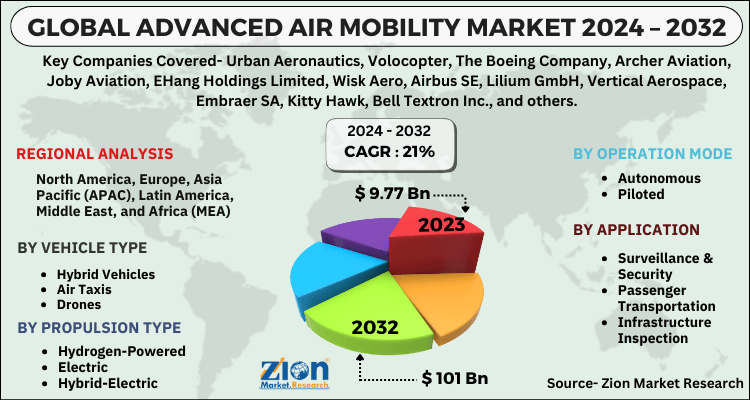
Analysts project explosive growth, albeit from a near-zero base. According to leading firms like Morgan Stanley, Deloitte, and Roland Berger, the global AAM market is estimated to be worth between $90 billion and $1 trillion by 2040-2050. The variance depends on the rate of regulatory adoption, cost reduction, and public acceptance. The first commercial passenger routes are expected to be operational around the 2025-2028 timeframe, beginning in specific corridors in cities like Dubai, Los Angeles, and Singapore.
Critical Challenges to Navigate
The path to scale is not without turbulence:
-
Certification & Safety: Achieving the highest possible safety standard (“aircraft-level” certification) for a new vehicle class is a monumental, time-consuming task.
-
Public Acceptance & Noise: Communities must accept eVTOLs overhead. Noise profiles, while significantly quieter than helicopters, must be validated in real-world settings.
-
Infrastructure Integration: Building vertiports in dense urban environments faces zoning, cost, and community integration hurdles.
-
Economic Viability: Achieving cost parity with premium ground transport (e.g., ride-hailing) is essential for mass adoption. This hinges on high utilization rates and eventual autonomous operation to reduce pilot costs.
-
Airspace Integration: Seamlessly blending eVTOLs with existing manned aviation and drone traffic requires robust, automated, and secure software systems.
The Future Vision: An Integrated Mobility Network
The ultimate success of AAM lies not in isolated sky-taxi rides, but in integration. The future urban commute might involve an e-scooter, a metro, an eVTOL air shuttle, and a micro-mobility vehicle—all booked and paid for through a single digital mobility platform. AAM will become a key component of the smart city, reducing commute times, lowering urban emissions, and providing new emergency and logistics capabilities.
Read More-
https://www.zionmarketresearch.com/de/report/steel-round-bars-market
https://www.zionmarketresearch.com/de/report/industrial-protective-clothing-market
https://www.zionmarketresearch.com/de/report/advanced-air-mobility-market
https://www.zionmarketresearch.com/de/report/bispecific-antibodies-market
https://www.zionmarketresearch.com/de/report/ethanol-market
https://www.zionmarketresearch.com/de/report/specialty-pumps-market
Conclusion
The Advanced Air Mobility market represents one of the most ambitious and complex engineering and logistical undertakings of the 21st century. It is moving past the prototype phase and into the gritty reality of certification, infrastructure build-out, and operational design. While hurdles remain, the confluence of need, technology, and capital is undeniable. The question is no longer if it will happen, but how, where, and how quickly it will become a normalized part of our urban fabric. The race for the skies has officially begun.